

- About

Getting to know us
- Industries
Industries
McMaster University: Exadata Cloud@Customer Case Study

Eclipsys has helped McMaster University maximize its investment in the Oracle Exadata Cloud@Customer solution. Read the story here
- Careers









Life at DSP-Eclipsys
- Contact Us
If AI Gave Your Team Ten Hours Back Every Week, What Would You Do?
Contents
Imagine you have ten people on your team. Each one saves ten hours a week using AI. That's 100 hours of additional capacity every week, without hiring anyone. Now what?
Do you look at those numbers and conclude that you need fewer people? Or do you start thinking about everything your team could accomplish with those additional hours?
I've been thinking about how AI is changing the way we work, and Gartner's 2026 Hype Cycle for the Future of Work brought up some interesting points. Not so much about what it can do, but about how we are choosing to use it and what that means for the people doing the work.
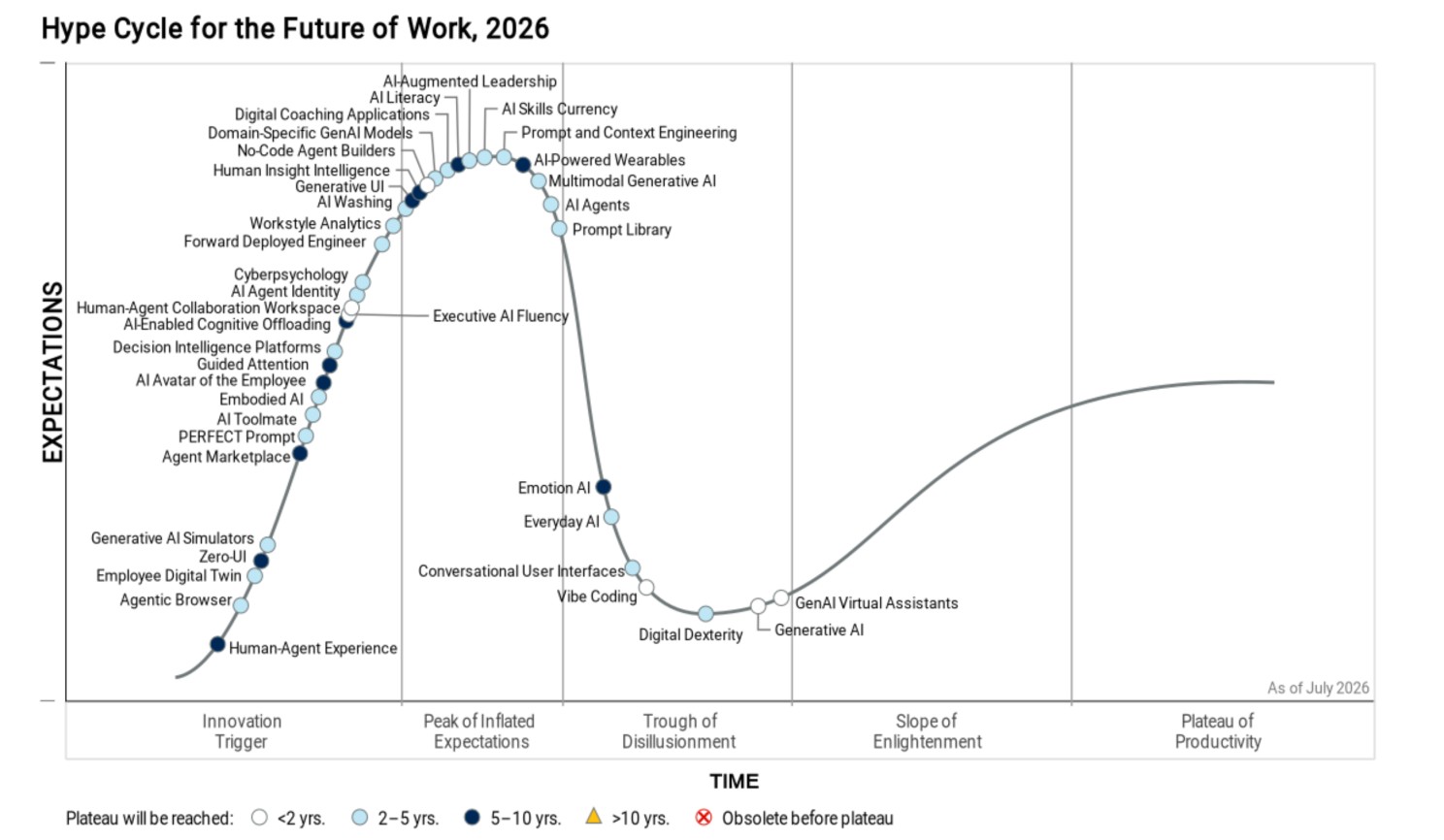
Gartner makes two predictions:
-
By 2029, 30% of employees laid off because they were replaced by AI will need to be rehired, often at a much higher cost.
-
By 2027, 75% of organizations that prioritize turning AI productivity gains into cost savings will be overtaken by competitors that reinvest those gains into innovation, modernization, and developing their people.
I think these predictions raise an important question about where we are heading.
Are we actually using AI to make our organizations better, or are we just looking for ways to reduce the number of people doing the work?
I think we are spending too much time discussing the second question and not nearly enough on the first.
We Have Been Here Before, but This Time Is Different
Having spent most of my career working with databases, infrastructure, and cloud technologies, I have seen several waves of automation.
We automated backups, database provisioning, infrastructure deployment, monitoring, patching, and many other activities that used to require hours or even days of manual work.
Did that eliminate the need for database administrators, infrastructure engineers, or architects? Not really. It changed what we expected from them.
Instead of spending hours executing repetitive tasks, we could spend that time working on performance, availability, architecture, security, and solving more complex problems.
Of course, some roles disappeared or evolved significantly along the way. Technology has always done that. But AI brings something different to the table.
We are no longer just automating repetitive activities. We are starting to delegate analysis, reasoning, recommendations, and even decisions to machines.
Think about those ten hours again. In the past, automation might have saved an engineer ten hours of manual work. Today, AI might save that same engineer ten hours of analysis, troubleshooting, and decision-making.
That is a very different type of productivity improvement, and one that comes with challenges we haven't completely figured out yet.
The Problem With Automating Knowledge
One of the concepts Gartner discusses is AI-enabled cognitive offloading. Essentially, we are moving some of our mental work to AI systems. There is nothing wrong with that. We have been doing something similar with calculators, search engines, and software for decades.
The difference is that AI can now perform tasks that previously required a certain level of expertise.
Think about a junior database administrator troubleshooting a performance issue. Today, that person could provide an AWR report to an AI model and receive an explanation of the bottlenecks, potential causes, and recommendations in seconds.
But what happens if that person never learns how to interpret the report independently? What happens when the recommendation is incorrect, the data is incomplete, or the situation requires understanding something not documented anywhere?
An experienced DBA might recognize that something doesn't make sense because they have spent years dealing with similar situations. Someone without that experience might accept the recommendation without questioning it.
Now apply that scenario to software development, finance, healthcare, cybersecurity, or almost any other profession.
If AI does all the thinking for the next generation of professionals, how are we going to develop the experts we will need in ten years?
This is something organizations need to take seriously.
Saving ten hours a week is great. But if those ten hours were previously spent developing experience, learning from mistakes, and understanding how things work, we need to think about what we might be losing along the way.
I don't believe the solution is to avoid AI. We should use it to help people learn faster, explore more possibilities, and develop skills that previously took years to acquire. The objective should be to make people better at what they do, not simply remove them from the process.
So, What Do We Do With Those Ten Hours?
I am very optimistic about AI. I use it, I experiment with it, and I genuinely enjoy seeing what we can build with it. I also believe many jobs will change significantly, and some activities that require people today will eventually be performed almost entirely by software.
That is not something we should ignore. But I don't think the objective should be to automate everything simply because we can.
If we remove all the repetitive work, we also need to think about how people will learn. If we delegate decisions, we need to understand who is responsible when things go wrong. And if we save thousands of hours through AI, we need to decide whether those hours become an opportunity to innovate or simply another cost reduction exercise.
There is nothing wrong with using AI to reduce costs. Sometimes that is exactly what a business needs to do. But if cost reduction becomes the only objective, we risk overlooking what might be the biggest opportunity AI brings us: the ability to do things we didn't have the time, resources, or expertise to do before.
Maybe those ten hours allow your team to modernize an application that has been running for twenty years. Maybe they allow a junior engineer to learn something new from a senior architect. Maybe they allow your team to spend more time talking to customers, understanding their problems, and developing better solutions. Or perhaps they give people some breathing room instead of constantly asking them to do more with less. All of those have value.
Over the next few years, we are going to see a significant difference between organizations that use AI primarily to reduce their workforce and those that use it to increase what their workforce is capable of accomplishing. The technology available to both might be exactly the same. What will be different is how they choose to use it. So I'll leave you with the same question I started with.
If AI gives your team ten hours back every week, what will you do with those ten hours?
Because I think the answer tells us more about an organization's AI strategy than how many AI agents it has deployed. In the end, that decision has very little to do with artificial intelligence. It is a human one.
Check out our AI Services here, or contact us today for more information and one of our experts will be in touch.