
- About

Getting to know us
- Industries
Industries
McMaster University: Exadata Cloud@Customer Case Study

Eclipsys has helped McMaster University maximize its investment in the Oracle Exadata Cloud@Customer solution. Read the story here
- Careers







Life at DSP-Eclipsys
- Contact Us
FinOps in the Age of AI: Why Visibility Is No Longer Optional
Contents
Introduction
We’re in a volatile moment for AI. Organizations are still figuring out how to work with these models, and testing is happening faster than understanding, especially when it comes to token-based costing.
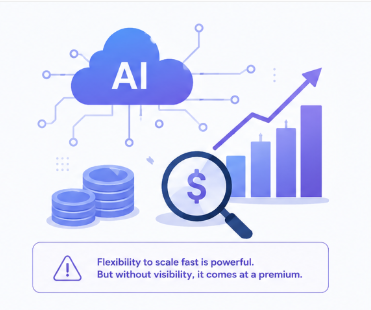
It’s a simple truth: the cloud gives you the flexibility to scale fast, but that flexibility isn’t free. Without visibility into where your spend is going, you end up paying a premium for the privilege of not knowing.
That’s exactly the gap FinOps is built to close. I recently came across the concept, and it struck me as one of those things that seems niche until you realize it’s foundational. A discipline every team investing in AI needs to understand before costs get away from them.
What is FinOps?
FinOps (short for “Finance” + “DevOps”) is a way of working that gets engineering, finance, and business teams talking to each other, rather than operating in silos, so a company gets the most value from its technology spending.
In plain terms, FinOps does three main things:
-
Shows you where your money is going: one shared view instead of five disconnected teams guessing
-
Warns you before you overspend: alerts when costs are trending up, or something looks off
-
Suggests ways to save: data-driven recommendations to cut unnecessary spend
The Real Problem: Multi-Cloud Blind Spots
Here’s something I’ve noticed with cost handling across hyperscalers: even though tools like Cost Explorer exist, you still miss important cost benchmarks. And when you’re working across multiple hyperscalers, you can’t monitor all their individual cost explorers at the same time. Each one lives in its own silo, with its own login and its own view.
That’s exactly where a single, simple dashboard becomes essential, something that pulls everything together in one place instead of forcing teams to jump between platforms.
Since many companies today use a multi-cloud approach, this creates a real gap: no unified visibility, and no single point of control over cloud expenses.
Where Finomics Comes In
This is exactly where a product like Finomics comes into the picture, bringing AWS, Azure, GCP, and other cloud costs together into one dashboard so teams get a single, unified view instead of juggling multiple cost explorers.
What is Finomics?
Finomics is an AI-powered tool that helps companies keep track of how much they’re spending on cloud services and AI (think AWS, Azure, Google Cloud, and various SaaS subscriptions), all in one place instead of scattered across different bills.
In plain terms, Finomics helps teams:
-
See all cloud spend in one dashboard: no more logging into five different consoles
-
Catch overspending early: real-time alerts when costs spike or trend the wrong way
-
Optimize automatically: AI-driven recommendations for where to cut costs
Tokonomics: Tracking What Your AI Models Actually Cost
One thing that really caught my attention within Finomics is Tokonomics.
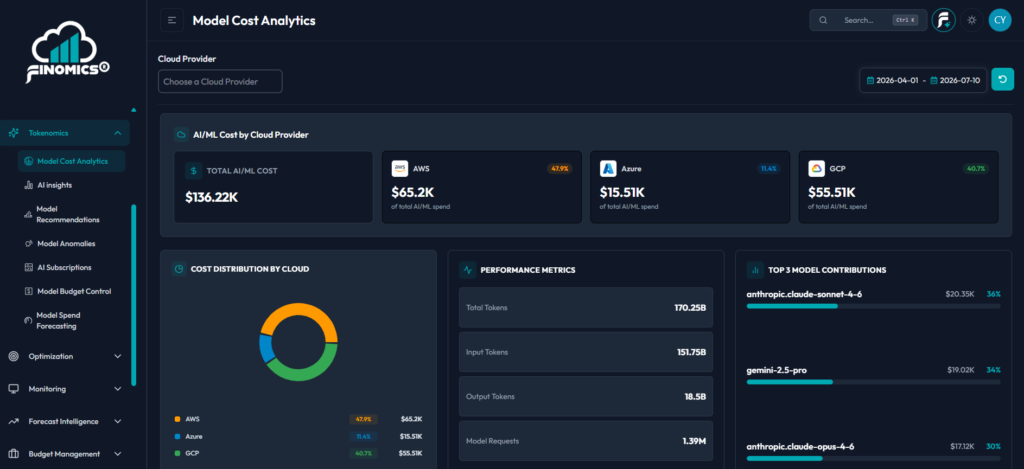
This dashboard shows you exactly which AI/ML providers you’re using. And here’s the thing to remember: hyperscalers each have different pricing models for different AI models, so understanding which model actually fits your use case matters. You also need to keep an eye on which models are costing you the most, and why.
Right now, most customers are still in the early stages of AI adoption. They’re experimenting with different models, and honestly, optimization feels like a distant priority. The current focus is on getting results, not necessarily on getting them efficiently.
That’s where Tokonomics helps. It gives you a clear view of which models are spending the most, lets you drill down into why, and even provides recommendations for lower-cost alternatives, among other things.
Conclusion
AI isn’t slowing down, and neither is cloud spend. The organizations that win won’t just be the ones adopting AI fastest; they’ll be the ones who can see, understand, and control what it’s actually costing them.
That’s the real promise of FinOps, and tools like Finomics and Tokonomics show what putting it into practice actually looks like: turning cloud spending from a mystery into a managed, strategic advantage.
For more information, check out our FinOps Services, or contact us today, and one of our experts will be in touch.